Color guide
Logo color psychology guide
Logo color psychology is the practice of using color associations carefully to support brand perception. It can help frame a choice, but color meaning is never automatic. Audience, category, culture, competitors, saturation, lightness, accessibility, reproduction, and repeated use decide whether a logo color actually works.
Short answer
Logo color psychology is useful when it is treated as a hypothesis, not a rulebook. Red, blue, green, yellow, purple, black, white, and other color families can suggest different associations, but those associations change with culture, industry, competitors, saturation, lightness, context, and execution. A strong logo color should support the brand position, differentiate the mark, reproduce reliably, work in one-color and reversed versions, and leave the wider brand system accessible.
- Color associations can influence perception, but they are contextual rather than universal.
- A logo color should be judged against audience, category expectations, competitor colors, culture, brand position, and real applications.
- Hue is only one part of the signal. Saturation, chroma, lightness, contrast, materials, typography, and shape change the psychological effect.
- A memorable logo color still needs practical variants: full-color, one-color, black, white, reversed, small-size, and background-tested versions.
- Accessibility matters around the logo. Logo artwork may have contrast exceptions, but taglines, UI, buttons, links, and brand applications still need readable pairings.
- The best brand systems document exact values, approved pairings, disallowed uses, and semantic tokens so color meaning stays consistent.
Standards status
Badges mark whether this guide relies on stable standards, draft or preview specifications, primary or model sources, Hue Codex guidance, approximations, or browser-dependent behavior.
What logo color psychology is
Logo color psychology studies and applies the associations people may attach to color in a brand mark. It asks how a color direction might support impressions such as trust, energy, calm, freshness, luxury, friendliness, seriousness, urgency, or creativity.
The important word is might. Color can influence first impressions, but it does not carry a fixed meaning by itself. A red mark can feel urgent, appetizing, political, festive, romantic, discounted, or dangerous depending on the audience and context. A blue mark can feel trustworthy, technical, corporate, cold, medical, generic, or premium depending on execution.
Logo color psychology is the use of color associations, audience context, category expectations, and brand strategy to choose logo colors that support a desired perception while still working in real brand applications.
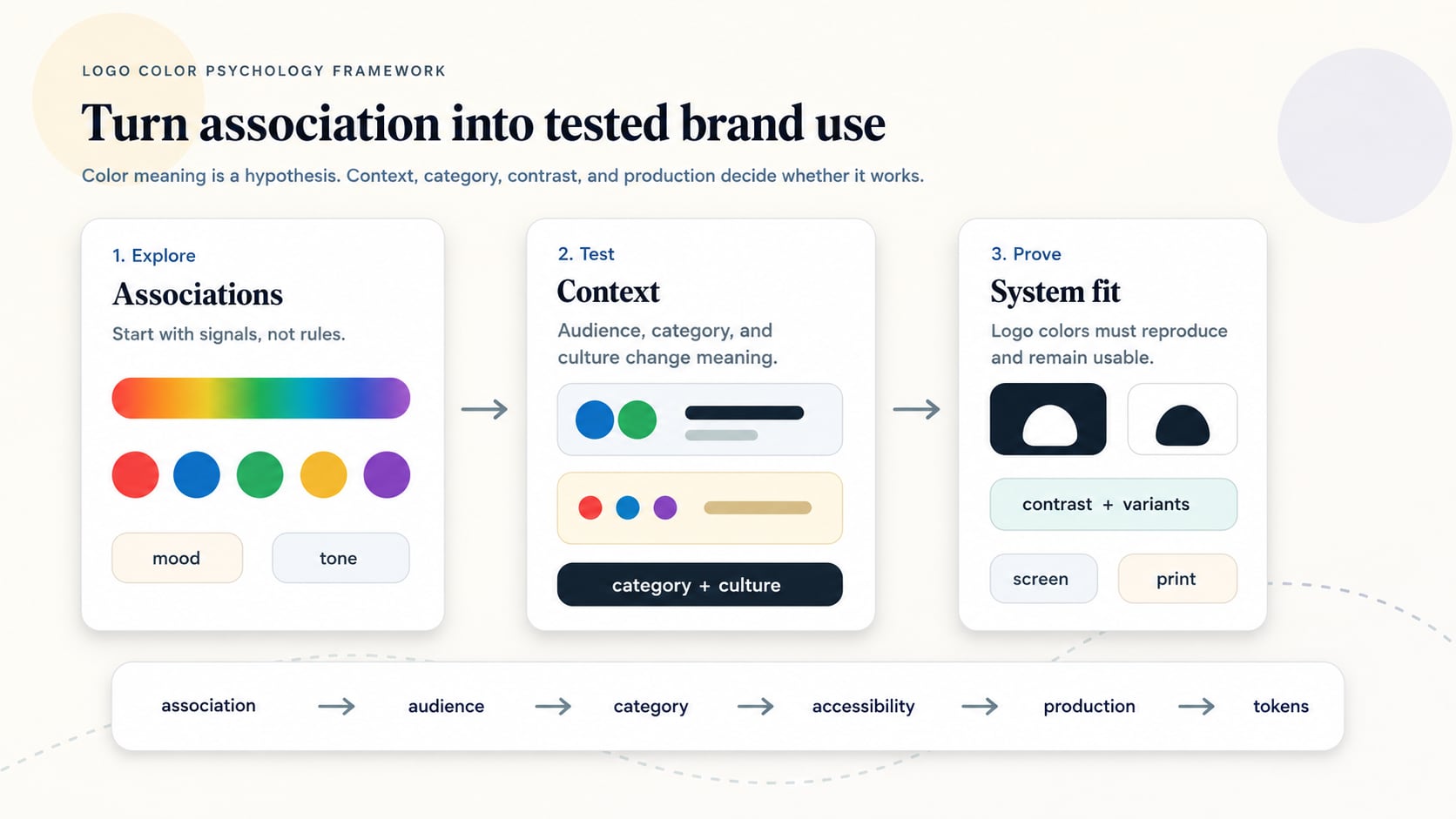
Color meaning is contextual
The same hue can send different signals in different markets. Green can suggest sustainability, finance, health, growth, freshness, approval, or agriculture. Black can suggest luxury, authority, simplicity, grief, rebellion, or editorial minimalism. Yellow can suggest optimism, caution, affordability, youth, sunlight, or low contrast.
This is why color psychology should start as a research prompt. Ask what the color tends to suggest in the specific category, culture, price point, visual style, and competitive field. Then test whether the actual logo execution supports that interpretation.
Audience changes meaning
Age, culture, geography, profession, purchasing context, and expectations can change how a color feels.
Category changes meaning
Blue in healthcare, finance, SaaS, education, and social media does not carry exactly the same signal.
Execution changes meaning
A muted navy, electric cobalt, pale sky blue, and violet-blue gradient can all sit in the blue family but feel very different.
Common logo color associations
Color association charts are useful only when they are treated as starting points. They can help teams discuss possible signals, but they should never replace audience research, category review, accessibility checks, or production testing.
The table below describes common brand associations and the main caveats. Use it to generate hypotheses, then test the actual mark and palette in context.
| Color family | Can suggest | Watch for |
|---|---|---|
| Red | Energy, appetite, urgency, confidence, passion, sale, action | Can also signal danger, error, aggression, politics, or discounting |
| Orange | Warmth, creativity, friendliness, movement, approachability | Can feel informal, loud, inexpensive, or difficult for serious categories |
| Yellow | Optimism, attention, sunlight, youth, cheer, caution | Often has low contrast on white and can feel cheap or warning-like if overused |
| Green | Nature, growth, health, finance, permission, freshness, sustainability | Can become generic in eco, wellness, finance, and food categories |
| Blue | Trust, stability, technology, clarity, healthcare, finance, calm | Can feel cold, corporate, overused, or indistinct in many categories |
| Purple | Creativity, imagination, premium tone, spirituality, beauty, playfulness | Can feel niche, trendy, artificial, or overly expressive in restrained markets |
| Pink | Care, softness, beauty, sweetness, youth, warmth, expressive confidence | Can be culturally loaded or too narrow if audience assumptions are shallow |
| Black | Luxury, authority, simplicity, sophistication, editorial confidence | Can feel severe, inaccessible on dark media, or emotionally cold |
| White | Simplicity, openness, purity, clarity, space, minimalism | Needs contrast and usually needs a surrounding system to avoid disappearing |
| Gray | Neutrality, maturity, technology, balance, restraint | Can feel dull, uncertain, low-energy, or disabled if role is not clear |
Hue, saturation, lightness, and chroma change the signal
Logo color psychology is not only about hue names. A dark green and a neon green can communicate completely different brand personalities. A pale pink and a saturated magenta do not feel the same. A black-and-white logo can feel premium, practical, editorial, or stark depending on shape and typography.
Saturation and chroma affect intensity. Lightness affects friendliness, weight, and contrast. Temperature affects whether the palette feels warm, cool, human, technical, energetic, or calm. These dimensions often matter as much as the hue family itself.
| Dimension | Higher or stronger feel | Lower or softer feel |
|---|---|---|
| Lightness | Bright, open, playful, soft, accessible when paired well | Serious, grounded, premium, dramatic, stable |
| Saturation | Energetic, youthful, loud, digital, expressive | Mature, calm, editorial, natural, restrained |
| Chroma | Colorful, vivid, distinctive, high-emphasis | Muted, neutralized, subtle, sophisticated |
| Contrast | Bold, clear, decisive, high-impact | Quiet, delicate, atmospheric, sometimes weak |
| Temperature | Warmth, approachability, appetite, urgency | Calm, technical, medical, distant, stable |
Audience, culture, and geography
Color associations are shaped by culture, language, religion, local symbolism, politics, seasonal rituals, sports, national identity, and category history. A color that feels lucky, premium, festive, or trustworthy in one context can feel inappropriate or confusing in another.
International brands should be especially careful. A global logo color does not need to mean the same thing everywhere, but it should avoid preventable conflicts in important markets and should remain usable across local media, languages, and cultural expectations.
Map priority markets
Review color meanings and category norms in the regions where the brand must perform.
Avoid shallow assumptions
Do not reduce a culture to one color meaning. Use research, local review, and real audience feedback.
Plan local applications
Campaigns, packaging, holidays, public-sector contexts, and partner co-branding can all change color interpretation.
Category fit versus differentiation
A logo color needs to balance recognition and distinction. Category color patterns help users understand what kind of product or organization they are seeing. Too much category fit, however, can make the brand invisible among competitors.
A competitor color audit helps separate useful category signals from sameness. Plot the dominant colors in the market, then decide whether the brand should conform, gently diverge, or deliberately break the pattern.
| Strategy | When it helps | Risk |
|---|---|---|
| Fit the category | New brands that need instant recognition or trust | Can look interchangeable with established competitors |
| Shift the category color | Brands that want familiarity with a distinct tone | May be too subtle if the market is crowded |
| Break the category pattern | Brands with a disruptive position or strong narrative | Can confuse users if the rest of the identity does not explain the choice |
| Own a distinctive accent | Brands that need recognition without abandoning category cues | Accent can become decorative if not used consistently |
Brand personality and color should align
A logo color works best when it supports the whole brand personality: naming, typography, shape, motion, copy tone, product experience, photography, materials, and UI. Color alone cannot make a brand friendly, premium, technical, rebellious, or trustworthy.
For example, a bright orange mark paired with rounded typography and informal copy can feel warm and approachable. The same orange paired with sharp type, black surfaces, and high contrast can feel athletic or urgent. The system creates the psychology.
Typography
Rounded, geometric, serif, condensed, and handwritten forms can change the emotional read of the same color.
Shape
A soft organic mark and a rigid angular mark make the same palette feel different.
Voice
Copy tone reinforces or undermines color associations. Serious language can cool a playful color, and casual language can soften a formal palette.
Logo color psychology by brand goal
Instead of asking which color is best, start with the perception goal. The same color can work or fail depending on whether the brand needs trust, speed, warmth, luxury, clarity, creativity, sustainability, appetite, or institutional confidence.
| Brand goal | Possible directions | Testing question |
|---|---|---|
| Trust and stability | Blue, deep teal, dark neutrals, restrained greens | Does it feel credible without disappearing into category sameness? |
| Energy and action | Red, orange, vivid coral, sharp contrast | Does it motivate without feeling aggressive or error-like? |
| Warmth and care | Soft coral, warm neutrals, gentle greens, moderated pinks | Does it feel human without becoming overly delicate or low contrast? |
| Premium or editorial | Black, white, deep neutrals, controlled metallic or muted accents | Does it feel confident without becoming cold or inaccessible? |
| Nature and wellness | Green, blue-green, earthy neutrals, fresh accents | Does it avoid generic eco signals and still reproduce well? |
| Creativity and imagination | Purple, magenta, expressive gradients, unexpected accents | Does it stay distinctive without becoming trend-dependent? |
Color psychology and accessibility
A color can support the right association and still be a poor production choice if it cannot be read, perceived, or applied safely. Logo artwork has some contrast exceptions in WCAG contexts, but the wider brand system does not. Navigation, buttons, taglines, form fields, icons, focus indicators, and marketing copy still need accessible color decisions.
Do not use color as the only way to communicate meaning. If a logo color also identifies product tiers, status, category, price, or audience segment, reinforce it with labels, shapes, icons, layout, or other cues.
Separate logo art from readable content
The mark may be brand artwork, but taglines, buttons, and product copy around it still need proper contrast.
Build accessible companions
Bright brand colors often need darker text variants, pale surfaces, border colors, and neutral supports.
Check color-vision differences
If brand meaning depends on red versus green or similar hues, add shape, labels, or other cues.
One-color, reversed, and small-size tests
Psychological intent does not matter if the logo fails in real use. Every serious logo color decision should survive one-color, black, white, reversed, and small-size tests. These tests reveal whether the mark has enough shape strength and whether color is carrying too much of the identity.
A one-color test is especially important. If the logo falls apart without color separation, the shape or typography may need refinement before color is finalized.
| Test | What it reveals | Decision |
|---|---|---|
| One-color logo | Whether shape carries recognition without hue separation | Simplify or strengthen the mark if recognition drops |
| Black version | Whether the mark works in documents and simple print | Approve a neutral dark value and export file |
| White or reversed version | Whether the mark works on dark or colored backgrounds | Define approved reversed backgrounds |
| Small icon | Whether color details survive favicon, avatar, and app-icon sizes | Create a simplified small mark if needed |
| Background test | Whether logo colors disappear or clash | Document approved and disallowed surfaces |
Color psychology in logo systems, not just marks
The logo is the most concentrated brand signal, but the psychological effect continues through the full color system. Website surfaces, product UI, packaging, social templates, illustration, charts, email, motion, and documents all reinforce or weaken the meaning of the logo color.
This is why a logo color should not be automatically used for every button, link, alert, chart, or background. The brand color may be excellent for recognition and weak for text contrast. It may work beautifully as a mark and poorly as a warning color. Assign roles before applying the color everywhere.
Identity role
The color used for the mark, favicon, avatar, and core brand recognition.
Interface role
Colors used for buttons, links, focus, states, and surfaces. These need contrast and interaction rules.
Expression role
Colors used for campaigns, illustration, packaging, and editorial moments. These need guardrails so the brand does not drift.
Digital and print reproduction
A logo color has to survive more than a design file. Screens, print, embroidery, signage, packaging, social avatars, presentation decks, and merchandise can all change appearance. Psychology can shift when a color becomes dull, clipped, oversaturated, or muddy.
Document exact digital values such as HEX and RGB, and document print values such as CMYK or spot color guidance when needed. For modern systems, OKLCH can help explain perceptual relationships, but the team still needs approved export values and proofing rules.
| Need | Document | Why it matters |
|---|---|---|
| Digital brand color | HEX, RGB, and optional OKLCH | Keeps web, UI, and color roles consistent |
| Print production | CMYK or spot color guidance | Protects brand color outside screens |
| Reversed use | Approved light mark and dark backgrounds | Preserves recognition in dark contexts |
| Accessibility companions | Foreground and background pairings | Prevents brand color from becoming unreadable UI |
| Export files | SVG, PNG, PDF, one-color variants | Avoids vendor recreation and color drift |
Logo color, trademarks, and ownership
Color can be part of trademark presentation in some situations, but logo color psychology is not legal protection. Whether a color can function as part of a protectable mark depends on jurisdiction, distinctiveness, use, registration strategy, and legal context.
From a design-system perspective, the key question is whether the brand wants the color presentation to be essential or flexible. A color-specific identity may need tighter controls. A more flexible identity may rely more heavily on shape, name, and typography so it works in black and white or one-color contexts.
Color-specific mark
Appropriate when exact color presentation is central to brand recognition and use can be controlled.
Flexible mark
Appropriate when the mark needs to work broadly across print, digital, partnerships, and vendor constraints.
Legal review
Trademark registration and protection questions should be reviewed with qualified counsel.
How to test logo color psychology
The safest way to use color psychology is to test it. You do not need a huge research program for every small brand, but you do need more than personal preference. Compare options against the brand strategy, competitors, audience language, and real applications.
- Define the intended perception in plain language, such as trustworthy, expressive, warm, premium, technical, sustainable, urgent, or playful.
- Audit competitor colors and category norms so the color choice has a clear fit-or-differentiate rationale.
- Create logo options with different hue, saturation, chroma, and lightness directions, not only different hue names.
- Test the options in real contexts: website header, favicon, social avatar, app icon, business card, packaging, dark background, and one-color use.
- Ask viewers what the mark suggests before explaining the brand. Look for repeated words, misunderstandings, and category confusion.
- Check accessibility, small-size behavior, print feasibility, and color-vision resilience before final approval.
- Document the selected color strategy as rules, values, variants, and semantic tokens.
Common logo color psychology mistakes
Most mistakes come from turning a useful association into an absolute rule. Color psychology can guide a conversation, but it cannot replace brand strategy, research, accessibility, or production checks.
Mistake: treating color meanings as universal
Associations vary by culture, category, context, and execution.
Mistake: choosing a color because competitors use it
Category fit can help recognition, but too much fit creates sameness.
Mistake: choosing a color only to be different
Differentiation should still support the brand promise and user expectations.
Mistake: ignoring saturation and lightness
A muted red and vivid red can communicate very different things.
Mistake: no accessibility companions
A logo color may need separate text, surface, link, and state colors to work in UI.
Mistake: no production proof
A color that looks perfect on screen can fail in CMYK, embroidery, signage, or small icons.
A practical logo color psychology workflow
The best workflow moves from meaning to proof. Start with the intended perception, use psychology as a hypothesis, test against context, then document the final color as a usable brand system.
- Write the intended brand perception and the audience the logo needs to reach.
- Map the category colors and competitor positions.
- Choose candidate color directions with clear rationale, including hue, saturation, lightness, and chroma.
- Evaluate cultural, geographic, and audience-specific risks.
- Test the mark in full color, one color, black, white, reversed, small-size, print, and digital contexts.
- Check accessibility for surrounding brand applications and define accessible companion colors.
- Document exact values, variants, backgrounds, token names, approved pairings, and disallowed uses.
How Hue Codex supports logo color psychology
Hue Codex helps translate logo color psychology into practical color decisions. Use the picker and converter to capture exact values, compare HEX, RGB, HSL, Lab, LCH, OKLab, and OKLCH, generate tints and shades, build supporting palettes, and test contrast for real foreground and background pairs.
That workflow keeps color psychology honest. The brand can choose a color for meaning, then prove it through accessibility, variants, role rules, and ready-to-use values.
Sources and further reading
This guide is written from practical brand identity and design-system usage and cross-checked against color psychology, marketing, trademark, CSS color, and accessibility references.
Try it in Hue Codex
Use the free tools to test the idea immediately: pick a color, convert it, generate harmonies, build tints and shades, check contrast, and export practical CSS or palette data.
Quick answers
Logo color psychology guide FAQ
What is logo color psychology?
Logo color psychology is the use of color associations, audience context, category expectations, and brand strategy to choose logo colors that support a desired perception. It is useful as a hypothesis, not as a universal rulebook.
Do logo colors have universal meanings?
No. Color associations vary by culture, category, audience, saturation, lightness, competitors, and execution. A color can suggest different things in different brand contexts.
What does red mean in a logo?
Red can suggest energy, urgency, appetite, confidence, passion, sale, or action, but it can also suggest danger, aggression, error, or discounting depending on context.
What does blue mean in a logo?
Blue often suggests trust, stability, technology, calm, healthcare, or finance, but it can also feel cold, corporate, generic, or overused in categories where many competitors use blue.
What does green mean in a logo?
Green can suggest nature, wellness, growth, finance, freshness, permission, or sustainability. It can also feel generic in eco, wellness, finance, and food categories if the brand does not differentiate.
What does black mean in a logo?
Black can suggest luxury, authority, simplicity, sophistication, or editorial confidence. It can also feel severe or cold if the rest of the identity does not soften it.
Should I choose a logo color based on psychology alone?
No. Use color psychology to frame options, then test audience fit, category context, competitor differentiation, accessibility, reproduction, one-color use, and real brand applications.
How many colors should a logo use?
Many logos work best with one to three core colors. More colors can work, but they require stronger variant, reproduction, and usage rules. Every logo system should still include one-color, black, white, and reversed versions.
Can a logo color hurt accessibility?
Yes. The logo artwork may have some contrast exceptions, but taglines, UI, navigation, buttons, links, focus indicators, and brand applications still need accessible contrast and non-color cues.
How do culture and geography affect logo color?
Culture and geography can change color interpretation through language, traditions, religion, politics, seasonal rituals, local category norms, and public associations. Important markets deserve local review.
How do I know if a logo color is too generic?
Audit competitor colors in the same category. If the brand color lands in the same cluster as everyone else, decide whether familiarity is useful or whether the brand needs a distinctive accent, tone, or alternate direction.
Can logo color be trademarked?
Color can be part of trademark presentation in some situations, but protectability depends on jurisdiction, distinctiveness, use, registration, and legal context. Consult qualified trademark counsel for legal decisions.
What is the best way to test logo color psychology?
Define the intended perception, compare options in real applications, ask viewers what the mark suggests before explanation, test one-color and small-size versions, check accessibility, and document final usage rules.
How should a brand document logo color psychology?
Document the intended perception, audience rationale, competitor context, exact color values, approved variants, accessibility companions, backgrounds, disallowed uses, and semantic token names.